
Vestibular Testing Melbourne
True Hearing provides comprehensive vestibular and balance assessment for adults and children experiencing dizziness, vertigo and imbalance. Our Melbourne vestibular service includes VNG, vHIT, caloric testing, VEMP and positional assessment, with results reported to your referring GP or specialist.
What is the vestibular system?
The inner ear is made up of two key components — the cochlea, which is responsible for hearing, and the vestibular system, which is responsible for balance. Within the vestibular system, there are five specialised structures dedicated to keeping us balanced.
- The Semicircular Canals: Each ear contains three semicircular canals — horizontal, anterior, and posterior — positioned at different angles to one another. Together, they detect rotational and angular head movements, helping the brain understand how and where the head is moving.
- The Otolith Organs: Each ear also contains two otolith organs — the utricle and the saccule — which are sensitive to gravity and linear movement. These structures help us detect movements such as accelerating forward, stopping suddenly, or moving up and down.
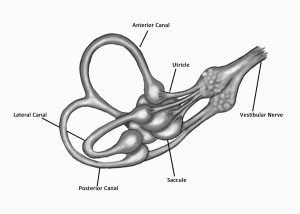
Under normal circumstances, both ears send balanced signals to the brain. When one ear is not functioning as it should, these signals become unequal, which can result in vertigo — a false sensation of movement or spinning. When both ears are affected, the brain may receive little to no movement signal at all.
Your balance system doesn’t rely on the inner ear alone — it also draws on input from your eyes and muscles to help maintain stability. And if part of the inner ear stops working, the brain has a remarkable ability to adapt and re-learn how to interpret the new signals it receives. While it can be tempting to avoid moving your head when experiencing symptoms, movement is actually an important part of the recovery process. One of the most effective ways to support this adaptation is through vestibular rehabilitation exercises, prescribed by a vestibular physiotherapist.
Vestibular function testing gives us a detailed picture of how well your balance system is working, helping to identify any inner ear weakness or irregularities that may be contributing to your dizziness or balance difficulties. Because the eyes and inner ear are closely connected, recording eye movements gives us a valuable window into how well your vestibular system is functioning.
Our Assessments
We offer specialised vestibular testing for adults and children experiencing dizziness or balance difficulties
-
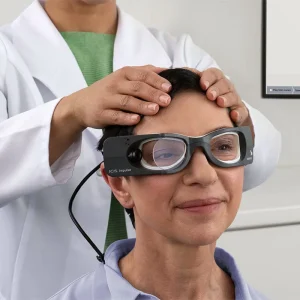
Video Head Impulse Test (vHIT)
Assesses how well the inner ear and brain communicate to keep your vision steady during rapid head movements.
-
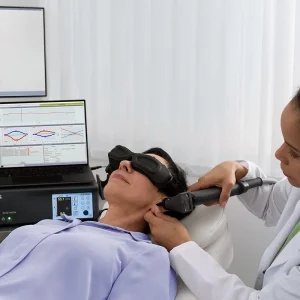
Caloric Testing
Uses mild air temperature changes to stimulate each inner ear separately, giving us a clear picture of how each side is functioning.
-
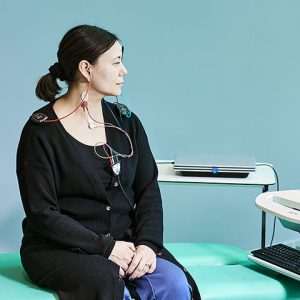
Vestibular Evoked Myogenic Potentials (VEMP)
Assesses whether your inner ear's gravity-sensing organs and their connections to the brain are functioning normally — measured through small muscle responses in the neck and under the eyes.
-
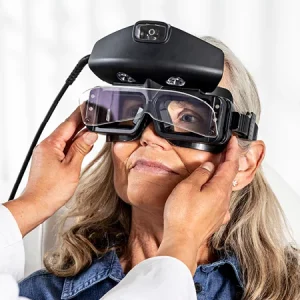
Videonystagmography (VNG)
Assesses through using an infrared camera to track your eye movements which are closely connected into the health of your vestibular system.
-
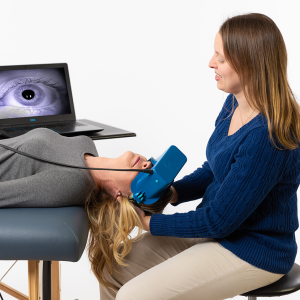
Positional Testing
Monitor eye movements during a series of gentle positional movements, allowing us to detect BPPV — the most common cause of vertigo.
-
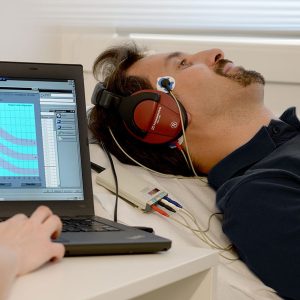
Auditory Brainstem Response (ABR)
Assesses how the auditory nerve and brain respond to sound.
-
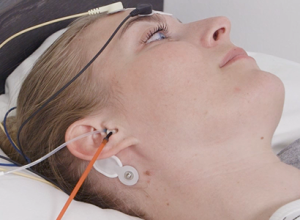
Electrocochleography (EcochG)
Assess the electrical activity generated by the cochlear and eighth nerve and can be used to assist with a Ménière’s diagnosis.
Preparing for Your Vestibular Assessment
Please follow these simple steps before your appointment
- Clothing: Choose comfortable, loose-fitting clothes and flat, supportive footwear. Some parts of the assessment involve gentle head and body movements, so freedom of movement is important.
- Make-up: Please come without eye make-up on the day — mascara, eyeliner, and eyeshadow can all interfere with the specialised cameras we use to track eye movements. If you use both contact lenses and glasses, we recommend opting for glasses on the day of your appointment.
- Eating & Drinking: Try to avoid a heavy meal in the two hours leading up to your appointment. A light snack earlier in the day is fine if needed.
- Alcohol & Smoking: Please refrain from alcohol for at least 48 hours before your assessment, as it can influence your results. We also ask that you avoid smoking for at least 24 hours prior to your appointment.
- Medications: Please avoid dizziness or motion-sickness medications (e.g. Stemetil, Serc, Ancolan, Torecan, Marzine), antihistamines, and sleeping tablets (e.g. Valium, Serepax, Mogadon) for at least 4 days before your appointment. We recommend speaking with your doctor before stopping any medication. If you take medication for your heart, blood pressure, breathing, or epilepsy, please continue these as usual.
- Getting Home: Some patients find their balance is temporarily affected following vestibular testing, so we recommend arranging for someone to take you home after your appointment rather than driving yourself.
Following your assessment, we provide your referring doctor with a detailed report outlining our findings and recommendations.
Our vestibular assessments are bulk billed with a valid referral from your GP or treating specialist.
Please allow approximately 3 hours for your appointment.
Request a call back
Please complete the below form and one of our friendly staff will call you shortlyFree Online Hearing Test
Hearing tests check a person’s ability to hear the loudness and pitch of sounds. Some reasons why you may need a hearing test include ringing in your ears, others companing that you talk too loud or watch the TV on high volume, or simply you have trouble hearing conversations.
While there’s no replacement for a consultation with a hearing-care expert, our free online hearing screening can provide some quick and useful feedback about your hearing. The screening should be carried out in quite space and all you need is a pair of headphones!
Type your details to start your free hearing test